


According to Kuwait Transformed by Farah Al-Nakib, “pre-oil Kuwaiti society could be divided into three distinct categories: urban-mercantile (townspeople), sedentary-pastoral (agricultural and fishing villages), and nomadic and semi-nomadic pastoral (Bedouin). In pre-oil Kuwait Town, the large, open-air market just outside of the city limits was known as al-Safat. In this large, undeveloped clearing, the Bedouin tribes of the surrounding hinterland set up temporary stalls where they traded their desert produce, such as milk, butter, ghee, horses, and sheep with the townspeople in exchange for dates, clothing, firearms, salt and manufactured items.”


Here is an image of Safat Square from Kuwait by the First Photographers. I believe that the old postcard, seen on eBay, is also of a Safat Square in its earlier days.
Over time, the urban suq (Mubarakiya) extended into al-Safat. The nature of the space began to change, people built cafés and other businesses. According to Mubarak Al-Sabah: The Foundations of Kuwait by Souad Al-Sabah, in 1915 a man named Abdullah Al-Zaydi placed a gramophone in a café he owned in Al-Safat Square. This was the first gramophone ever to be used in Kuwait and many flocked to his café to listen.


In Iridescent Kuwait, Laura Hindelang writes that, “Safat Square lastingly shaped the urban morphology of Kuwait Town. From the 1930s onward, the Department of Finance, the police station, the British Bank of the Middle East, the Security Department, coffee ships and the baladiyya, the municipality founded in 1930, began framing the always-busy square.” Al-Safat became the main town square used for public festivities; in the 1940s a traveling cinema came to Kuwait. As many as 10,000 people attended the first showing, sitting on the ground in the middle of the square to watch the film. Later, in 1954, the Kuwait National Cinema Company was established. A notable early cinema was Al Hamra, which was later demolished and Al Hamra tower was built in its place. Here is Safat Square in 1967:


The photographs below come from old postcards listed on eBay, the flickr of Verity Cridland, or this instagram account.


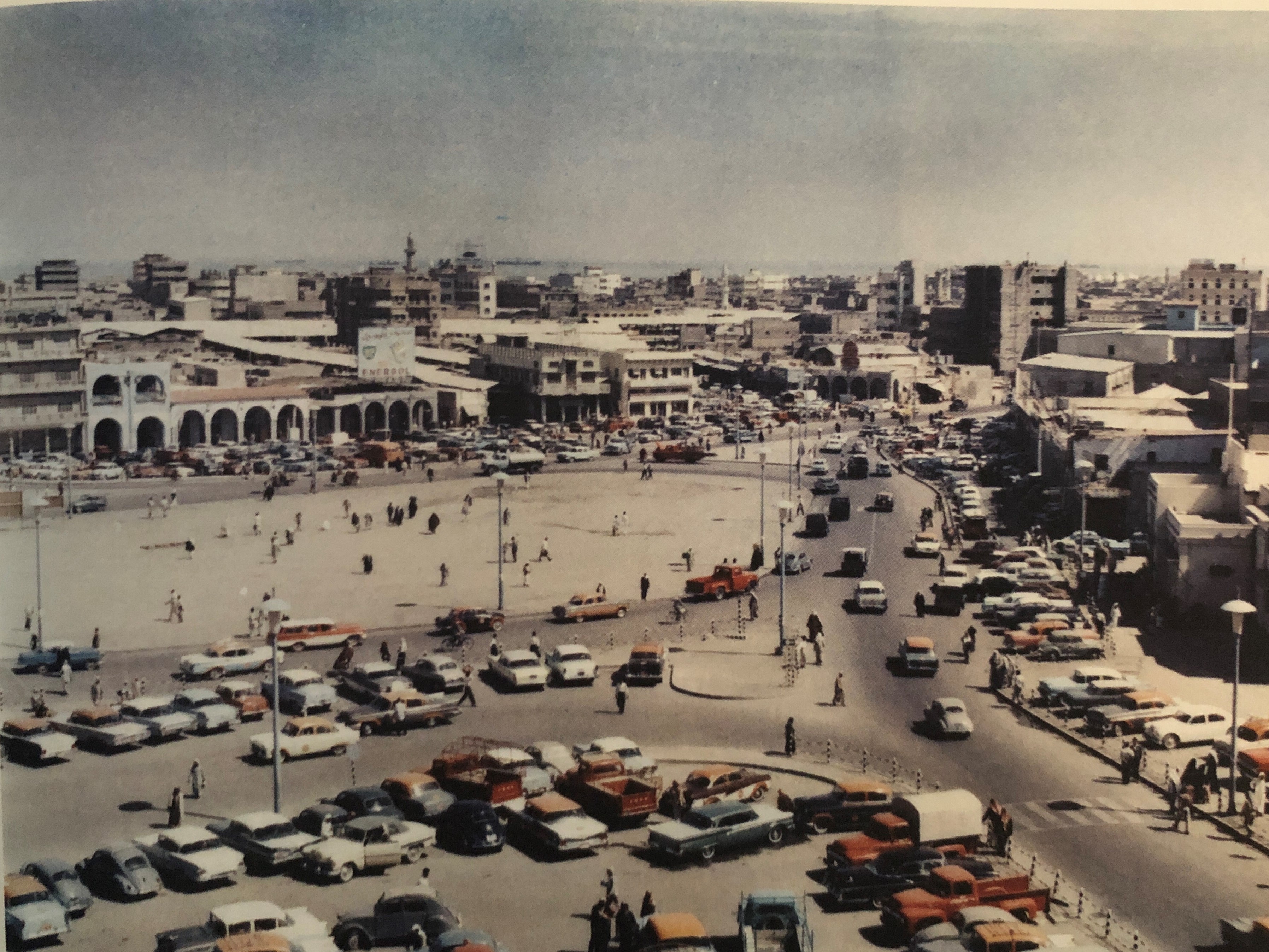


The street entering into Mubarakiya from Safat Square is known as “New Street.” There is a building on the left that you can see in old photographs, dating back to the 1950s-60s.


Jashanmals Store is now the location of Safat Al Mubarakiya, a new luxury complex. The 2022 fire that destroyed a section of Mubarakiya was next to this complex.


Here are various old images of Safat Square


[…] of the new city developed with a certain amount of site planning. The thoroughfare was built from Sahat al-Safat to Jahra Gate (one of the gates from the old city wall). In 1960, Fahad al-Salem was the only […]
[…] Safat Square […]
[…] Safat Square […]
[…] Safat Square: mentioned in the Fabbri excerpts above, it has traditionally been the main public space in Kuwait […]
[…] notable site in Mubarakiya is Safat Square. In pre-oil Kuwait Town, it was the large, open-air market just outside of the city limits. The […]